The next social network
October 18, 2026
Non-consensus thesis
- Personal agents like GrokBot, Muse, and Dots will grow 1000x in usage over the next N years and will become where 90% of your phone time goes. Why?
- UIs are counterintuitive to humans. We constantly spend brainpower learning new UIs just to do basic things. Filling in a government form? Shitty UI. Ordering clothes? Shitty UI.
- Today, the human brain has to keep track of most of the context, which is very inefficient. You enter your clothing sizes every time you shop at a new store, and you fill in government forms from memory. In the future, this context will live in your agent, and your agent will do this for you. Which means → Your agent will be like your second brain and will know more about you than your family and friends.
- When the mainstream realizes how good personal agents are, the mainstream will adopt them. As of October 17, Meta Muse is only 39 days old, and adoption will be exponential over the next two years. Your mom will be using Muse a lot in the near future.
- Meta Muse ONLY has 2,000 apps in its app store. Building on personal agents today is like building iPhone apps before the App Store even launched.
- This creates the first inflection point in social in a decade: the first opportunity for a new social app that doesn’t just reskin existing infrastructure.
What is the product?
- It lives inside your agents (e.g. Muse, GrokBot, OpenAI Dots) as an app.
- The first stage, based on current infrastructure, would be an MCP server that taps into the personal agents’ rendering layers.
- It is the connection layer for the age of personal agents.
- It will be a network of tens of millions of people, where we tap into personal agents in a data-safe way to access all the context in your second brain.
- With this context, we will know everyone’s goals and ambitions. That lets us connect people in a way that has never been done before, with connections so good that every party gets an enormous amount of value every time.
- This will be the most valuable product for human connection, on both a professional and personal level, that has ever been built. It will connect you with people so well that most of the value in your life will come from our network.
- The product depends on us solving the perfect memory layer and graph system along the way.
- Concretely:
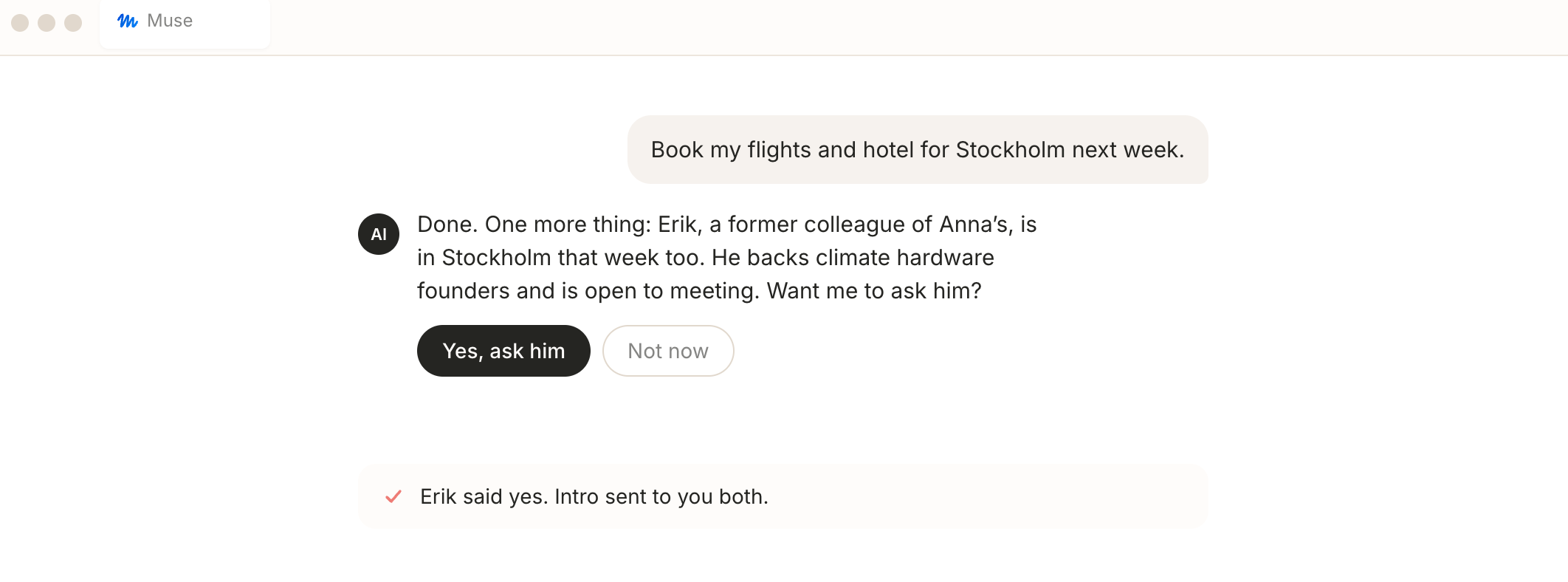
Competitor differences
The two products that align most closely with what we’re doing:
- Boardy
- Gigi
Boardy
Bad:
- Boardy is not built natively for personal agent infrastructure.
- Boardy fails at value generation. The product consists mostly of founders looking for funding and investors, and founders outnumber investors 9 to 1. Investors were frustrated by this.
- Execution generally feels poor and off from an outside point of view. Our calls with former employees gave us the impression of bad judgment.
- They tried to raise $100 million while their paid plan was perceived to cost $10k a month. It didn’t work out, and they raised $8 million instead.
- Context sharing relies on users feeding in information manually, which kills the vision of perfect connections.
Good:
- User stories of meaningful interactions.
- 250k users.
- Experienced founder whose last company reached a $3 billion valuation.
Gigi
Bad:
- Has pivoted many times and only recently pivoted to its current idea.
- Standalone app, so it could struggle to be sticky.
Good:
- Being a standalone app solves the challenge we face, because the context they need lives in their own ecosystem. That accelerates progress at an early stage.
TL;DR on Gigi: We don’t know enough yet, and it’s too early to judge the current product.
All problems with the new product
Note: Under each problem is a collapsible section with our initial thoughts on how we'd answer it.
1. The product has to be almost invisible
For this to work, it needs to be so frictionless that people barely notice it's installed, especially when it isn't doing anything for them.
Why? The product is built on network effects and scarce introductions. Many users might go weeks without an intro, because we only want to make intros that are a strong fit.
The technical structure we're envisioning:
- We use third-party connections to read all Claude and Codex conversations in our cloud.
- Based on that context, we build an internal notification system through the MCP.
- Our product pushes a message through our API.
- The harness detects it and mentions it naturally the next time the user sends a message.
This depends on one major assumption: that the platforms' OAuth APIs will let us access and parse every relevant conversation. We can't do this today, and the odds of being allowed to are low. Without it, the whole experience breaks.
The alternative is an MCP tool that constantly updates the user's context as they chat. I don't think the product works in that version. Since intros are intentionally scarce, users would spend weeks watching the tool get called with nothing coming back from our product. That creates anxiety and makes the product feel invasive, to the point where people remove it.
Initial thoughts on objection
The "weeks of silence" risk is a cold-start problem, not a design problem. If we onboard a curated, high-quality first cohort, we can make strong introductions from the first week, so Hop is never idle long enough to feel invasive. Once it delivers value regularly and becomes a habit, users will share context willingly and keep sharing it. Context follows value, not the other way around.
2. How do we avoid repeating Boardy's problem?
Boardy's value was uneven: most founders were mainly looking for investors.
If one group consistently wants something from another, and the other group has little reason to participate, the network doesn't work. We need to be clear about what each side gets and why it's strong enough for both to keep participating.
Initial thoughts on objection
We only match when both sides have stated intent. Founders and investors will each say what they want up front, and the GTM team actively recruits whichever side is underrepresented rather than letting the ratio drift. Starting with accelerators and incubators (see Problem 5) also gives us a market where both sides already want each other.
3. GTM requires an insanely large number of users, and even then the interactions might not make sense
GTM is critical to this idea and we need an insanely high number of users.
Even at scale, there's the hard problem that on LinkedIn, many people are trying to reach upward, and many interactions don't make obvious transactional sense. Why would a PhD take a call with a young student doing discovery for their startup?
How will our AI know users well enough to see when that interaction could still be valuable for both sides? Do we ask clarifying questions about each user's goals? Or, if we're betting on the harnesses for mass adoption, does Muse solve this on their end?
We can't assume the algorithm will understand hidden motivations and make asymmetric interactions work. That has to be proven.
Initial thoughts on objection
We don't need a huge network, but what we do need is relevant density. Communities are organized in clusters, and every community is relevant to a neighboring one, so we start with one, prove the mechanism, and expand along the connections it creates. We do things that don't scale: organized events and hand-picked communities. That also stress-tests the matching before we open it up.
On asymmetric intros (the PhD taking a call with a student), our profile has to understand people on a personal level, including what they'd do without a transactional reason, like mentoring or pro bono help.
4. We may still be missing the people who hold the most value
Many people use LinkedIn because the decision-makers are there, including older people inside large enterprises.
Even if we win Gen Z, there is still a value gap, where we might have a large network of younger people but no way to connect someone with, say, a manager at the largest railway company in the US.
If those people aren't using Claude, Codex, Muse, or whatever harness we integrate with, how do they enter the network?
Initial thoughts on objection
We're betting AI agents become the smartphones of the future, and this forces senior people in positions of power to adopt the same way they did with smartphones and LinkedIn. Hop has to be good enough to create the same pull where the value is too high to ignore.
5. Are investors and founders even the right starting market?
Founders will naturally want access to investors, but investors only want a small percentage of those founders. That creates uneven value from day one.
We need to know whether this market is a strong initial wedge or a trap that recreates Boardy's mistakes.
Initial thoughts on objection
Accelerators and incubators are a better starting point because they're less transactional than investing, and both sides actively want each other: accelerators do outbound search for promising talent ("unsharpened diamonds"), and that talent wants in. One accelerator brings its staff, its current batch (who need to connect with each other and with mentors), and the students and hubs it recruits from, all of which are high-density. Each new program extends the network to the next cohort.
6. If the context APIs become real, what data do we actually own?
If Muse and OpenAI Dots ship APIs that access 100% of a user's context, how that will most likely work is you are running your algorithms on their server side to not expose any of the context data to the outside. This becomes a disaster for us because if we do not own the context data, what are we even building the graph around?
We need to know what becomes proprietary over time: the relationship graph, the intro outcomes, the trust data, the memory graph, or something else. If the platforms can reproduce what we do with the same context, our ownership of the network is much weaker than it looks.
Initial thoughts on objection
We need to think more about this.
7. How does this become defensible enough to be a Meta level company?
If the product is mainly an MCP tool that reads context and suggests intros, Claude, ChatGPT, or another harness could absorb it as a feature. The network needs to compound in a way they can't easily reproduce.
We need a clear answer for what gets stronger with every user, conversation, and introduction.
Initial thoughts on objection
We see Hop working a lot like Visa does for payments, where adding a "Pay" button to a website is easy but building the network of banks and merchants that actually makes that button work is the hard part. In the same way, Claude or ChatGPT could add a "find someone" feature, but it only works if the right people are already in the network, we know what kind of intros they're open to, and we have permission to reach out on their behalf. The MCP tool is just how people reach Hop, and the network behind it is what we're actually building.
8. The memory graph has to be technically better than everything else
Our memory graph needs to be better than every existing system, not just good enough to support intros.
If the product depends on understanding people better than the harnesses do, this has to be a real technical advantage. If our memory graph is worse than Claude's, OpenAI's, Muse's, or another dedicated memory system, we're building the network on a weaker understanding of the user than the platforms already have.
Initial thoughts on objection
We don't need the best general-purpose memory, because what we do need is the best introductions. The benchmark is whether Hop can find a relevant, willing person, explain the fit, and take an allowed action correctly. If our intro KPIs show clear value from the start, memory quality is proven where it matters.
9. Meta will be the shark
This idea will seem obvious in hindsight, and if this market becomes a monopoly with Meta as the leading player, it will be an obvious product for them to build. It aligns closely with their mission because Meta is already about connecting people, so we will most likely end up competing with them. Right now, Meta is in the best position to win the battle of personal agents.
Initial thoughts on objection
Would not be the first time Meta fails.We are starting with the connection wedge, then we are building the agentic infrastructure for all human communication.
Read long-term vision